This review of UK company formations in 2025 provides an overview of the latest official statistics on incorporations, dissolutions, and the wider business population. Drawing on data from Companies House, the Office for National Statistics (ONS), and the Department for Business and Trade (DBT), it highlights how new compliance rules, rising costs, and global economic pressures have shaped the business landscape over the past financial year.
- Company numbers are still rising, but incorporate-and-close churn is intensifying, with record dissolutions and many firms already in dissolution or liquidation.
- The ECCT Act is reshaping behaviour, as higher fees and tougher scrutiny curb new incorporations and accelerate strike-offs, rather than simply enlarging the register.
- Different datasets reveal distinct economies: Companies House shows legal churn, ONS captures the tax-registered core, while DBT exposes millions of micro-businesses otherwise invisible.
- Sector and regional patterns diverge: construction dominates when micro-firms are counted, London’s high density skews UK averages, and finance is quietly contracting.
UK Company Formation: Key Figures at a Glance
At the end of March 2025 (the financial year ending 2025), the Companies House register contained 5.43 million companies. This represented an increase of 77,028 compared with the previous year, underlining the continued scale of UK company formation despite tighter rules and rising costs.
Breakdown by UK jurisdiction:
| Jurisdiction | Companies at 31 March 2024 | Companies at 31 March 2025 | % Change 2024-25 | Share of UK total (2025) |
|---|---|---|---|---|
| England & Wales | 5,000,825 | 5,066,168 | +1.31% | 93.4% |
| Scotland | 261,812 | 268,876 | +2.70% | 5.0% |
| Northern Ireland | 88,122 | 92,743 | +5.24% | 1.7% |
| United Kingdom | 5,350,759 | 5,427,787 | +1.4% | 100.0% |
The chart shows each UK jurisdiction’s share of companies as of March 2025.

Changes in the Companies House Register
| Indicator | FYE 2024 | FYE 2025 | Change vs. FYE 2024 |
|---|---|---|---|
| New company incorporations | 890,684 | 801,864 | −10.0% |
| Dissolutions | 663,167 | 726,735 | +9.6% |
| Companies on the register (total) | 5,350,759 | 5,427,787 | +1.4% |
| Companies in the process of dissolution/liquidation | 474,385 | 555,494 | +17.1% |
Private limited companies continued to dominate, accounting for more than 95% of all corporate bodies on the register. While the register continues to expand, the pace of growth slowed significantly compared with earlier years.
Methodology and Data Sources
This review is based on official statistics, with analysis prepared by Uniwide Formations.
The main focus is on Companies House data covering legal entities in the financial year from 1 April 2024 to 31 March 2025. This was the first full financial year since the Economic Crime and Corporate Transparency (ECCT) Act began implementation on 4 March 2024, introducing new compliance requirements and higher filing costs.
To give a wider picture, we also use figures from the Office for National Statistics (ONS) and the Department for Business and Trade (DBT). Each dataset measures something different:
- Companies House counts every incorporated body on the register — including active, dormant, and those in liquidation or dissolution, as well as charities set up as companies. It is the best source for understanding the size of the register and the churn in incorporations and dissolutions.
- The Office for National Statistics (ONS) measures only businesses that are registered for VAT and/or PAYE. A group of companies under the same ownership may be treated as a single business. This gives a smaller but sharper view of economically active, tax-registered businesses, while excluding very small firms that do not reach VAT/PAYE thresholds. The reference date for this release is 14 March 2025.
- The Department for Business and Trade (DBT) publishes Business Population Estimates. These extend the ONS base by adding very small, unregistered businesses such as sole proprietors and partnerships, while excluding public bodies and charities. This makes DBT figures the broadest measure of the private sector. However, totals can appear slightly lower than Companies House because non-trading incorporated bodies are excluded. The latest DBT data available is for the start of 2024, with updated figures for 2025 due in October.
It is important to note that these sources use different reference dates: Companies House at the financial year-end (31 March), ONS in mid-March, and DBT at the start of the calendar year. These timing differences explain why totals do not always align exactly.
Taken together, the three datasets complement each other: Companies House shows the churn of incorporations and dissolutions, the Office for National Statistics focuses on the active tax-paying core, and the Department for Business and Trade gives the fullest view of the private sector, including millions of the smallest firms.
New Company Incorporations
Incorporations fell to 801,864 in FYE 2025, down from almost 891,000 in the year before.
By country:
| Country | FYE 2025 | Change | % Change |
|---|---|---|---|
| England & Wales | 748,021 | −84,732 | −10.2% |
| Scotland | 38,631 | −2,206 | −5.4% |
| Northern Ireland | 15,212 | −1,882 | −11.1% |
| UK Total | 801,864 | −88,820 | −10.0% |
The decline can be explained by several factors:
- Persistently high inflation and interest rates continued to weigh on new business activity.
- Global uncertainty, including conflicts in Ukraine and the Middle East, added further instability.
- In addition, Companies House increased its incorporation fee in May 2024 from £12 to £50, the first rise in many years, linked to the implementation of the Economic Crime and Corporate Transparency Act.
Company Dissolutions
Company Dissolutions reached 726,735 in FYE 2025 — the highest number on record. This marked a 9.6% increase compared with the year before.
In our view, one likely reason may have been Companies House’s new powers under the Economic Crime and Corporate Transparency (ECCT) Act, allowing the Registrar to challenge filings more actively and accelerate strike-off processes.
Types of UK Companies and Businesses
As explained earlier, the UK has three main sources of business statistics, and each measures something slightly different. Companies House records all incorporated bodies — from private limited companies to LLPs — whether they are active, dormant, or in liquidation. In contrast, the Office for National Statistics (ONS) only counts businesses that are registered for VAT and/or PAYE, which means that very small unregistered firms are excluded. Finally, the Department for Business and Trade (DBT) goes further by combining ONS data with estimates for unregistered micro-businesses, offering the broadest picture of the private sector.
To understand the full picture of UK business activity, let us explore what each dataset reveals.
Companies House Register Breakdown
Companies House records all corporate bodies on the UK register. This goes beyond companies in the narrow sense and also includes bodies such as charitable incorporated organisations, overseas companies with a UK establishment, and registered societies.
At 31 March 2025, there were 5.43 million companies on the register. If we include all corporate body types, the figure rises to 5.65 million. The difference reflects the fact that the official headline statistics usually report only “companies”, whereas the corporate body type breakdown covers every incorporated form.
Three corporate body types continued to dominate the register:
- Private limited companies
- Limited partnerships
- Limited liability partnerships (LLPs)
These three together accounted for 98% of all corporate bodies. Private limited companies alone accounted for more than 95% of the total.
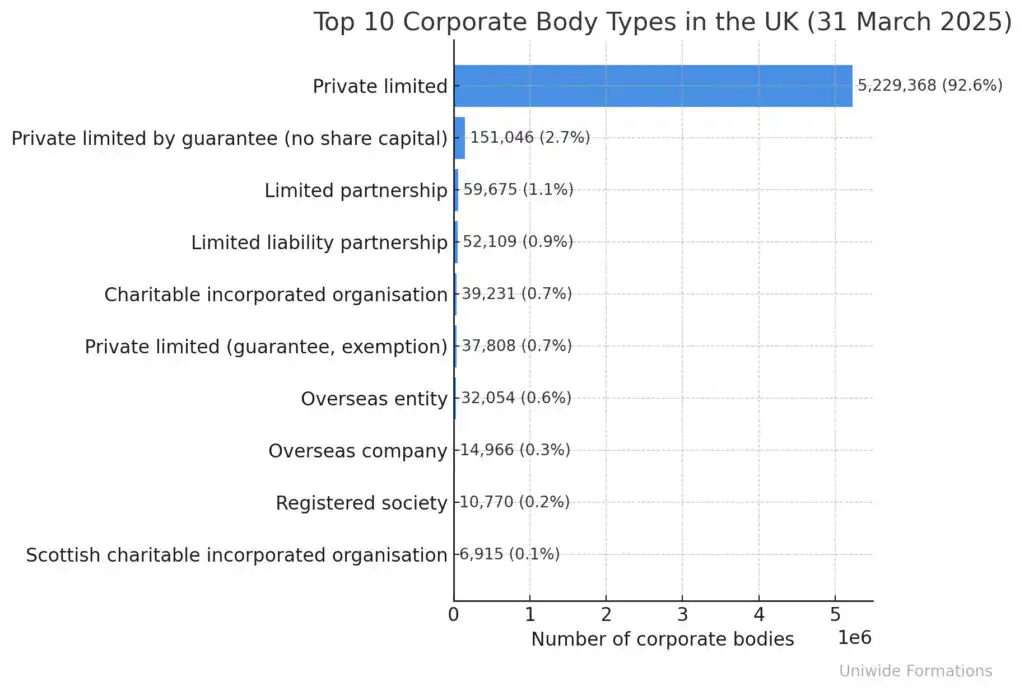
Top 10 Corporate Body Types in the UK
| Rank | Corporate Body Type | Number | % of Total |
|---|---|---|---|
| 1 | Private limited by shares | 5,229,368 | 92.6 |
| 2 | Private limited by guarantee (no share capital) | 151,046 | 2.7 |
| 3 | Limited partnership | 59,675 | 1.1 |
| 4 | Limited liability partnership | 52,109 | 0.9 |
| 5 | Charitable incorporated organisation | 39,231 | 0.7 |
| 6 | Private limited (guarantee, exemption) | 37,808 | 0.7 |
| 7 | Overseas entity | 32,054 | 0.6 |
| 8 | Overseas company | 14,966 | 0.3 |
| 9 | Registered society | 10,770 | 0.2 |
| 10 | Scottish charitable incorporated organisation | 6,915 | 0.1 |
| — | Other corporate body types | 13,804 | 0.2 |
| — | Total | 5,647,746 | 100.0 |
The chart below illustrates the primary corporate body types registered in the UK.
Economically Active Businesses
The Office for National Statistics (ONS) measures only businesses that are actively registered for VAT and/or PAYE, thereby excluding very small firms without VAT or PAYE. This presents a narrower view than that of Companies House, but one that reflects a more active segment of the economy.
As of March 2025:
- There were 2.73 million VAT/PAYE businesses in the UK, up 0.4% on the year before.
- Companies and public corporations accounted for 76.7% of this total.
- The proportion of sole proprietors and partnerships had fallen to 19.8%.
Businesses by Legal Status, March 2025
| Status | Count (March 2025) | Annual % Change (March 2024) | Share of Total (%) |
|---|---|---|---|
| Company (including building society) | 2,096,600 | +1.8 | 76.7 |
| Sole proprietor | 380,520 | −4.1 | 13.9 |
| Partnership | 160,865 | −3.9 | 5.9 |
| Non-profit body or mutual association | 84,000 | −5.3 | 3.1 |
| Local authority | 9,115 | +0.6 | 0.3 |
| Central government | 3,350 | −3.5 | 0.1 |
| Public corporation or nationalised body | 165 | −5.7 | 0.0 |
| Total | 2,734,615 | +0.4 | 100.0 |
Private Sector Business Population
The Department for Business and Trade (DBT) publishes Business Population Estimates that extend beyond Companies House and the Office for National Statistics (ONS). These figures also include very small, unregistered businesses that are not on VAT or PAYE, providing the most complete picture of the UK’s private sector.
At the beginning of 2024, the UK private sector comprised 5.5 million businesses:
- 56% were sole proprietorships,
- 38% were companies, and
- 6% were ordinary partnerships.
Only 48% of these businesses were VAT or PAYE registered, while the remaining 52% operated as unregistered micro-businesses.
UK Private Sector Businesses by Legal Form, 2024
| Legal form | Businesses (approx.) | Share of total (%) |
|---|---|---|
| Sole proprietorships | 3,080,000 | 56 |
| Companies | 2,063,000 | 38 |
| Ordinary partnerships | 356,000 | 6 |
| Total | 5,498,990 | 100 |
Of the 5.5 million businesses, almost 3 million were unregistered, meaning that they traded without VAT or PAYE. By comparison, the Office for National Statistics (ONS) recorded 2.6 million VAT/PAYE-registered businesses, or 48% of the total. Registration rates varied widely: only 13% of sole proprietorships and 47% of ordinary partnerships were VAT/PAYE registered.
This illustrates that the statistics of the Office for National Statistics capture only about half of the private sector, while the estimates of the Department for Business and Trade (DBT) reveal the broader entrepreneurial base across the UK, including millions of the smallest firms.
Overseas Companies with a UK Establishment
These are companies incorporated abroad but with a UK branch or place of business. They are different from entities listed on the Register of Overseas Entities.
At the end of FYE 2025, there were 14,574 such companies, compared with 14,299 at the end of FYE 2024. This represents a 1.9% increase.
Top 10 countries of origin (companies active on the UK register at 31 March 2025):
| Rank | Country | Companies |
|---|---|---|
| 1 | United States | 2,723 |
| 2 | Channel Islands | 1,986 |
| 3 | Ireland | 1,320 |
| 4 | Netherlands | 669 |
| 5 | Germany | 646 |
| 6 | Isle of Man | 546 |
| 7 | France | 308 |
| 8 | India | 307 |
| 9 | Cayman Islands | 296 |
| 10 | Australia | 289 |
New registrations in 2025 came from a wide range of countries:
| Rank | Country | New registrations | % of Total |
|---|---|---|---|
| 1 | Channel Islands | 220 | 26.0 |
| 2 | United States | 99 | 11.7 |
| 3 | Ireland | 76 | 9.0 |
| 4 | Germany | 44 | 5.2 |
| 5 | Marshall Islands | 33 | 3.9 |
| 6 | Netherlands | 17 | 2.0 |
| 7 | France | 15 | 1.8 |
| 8 | Isle of Man | 15 | 1.8 |
| 9 | British Virgin Islands | 14 | 1.7 |
| 10 | Australia | 13 | 1.5 |
| 11 | Cayman Islands | 13 | 1.5 |
| — | Other | 287 | 33.9 |
| — | Total | 846 | 100.0 |
Number of UK Businesses by Region
Companies House currently does not provide statistics on the number of companies by UK regions beyond England and Wales, Scotland, and Northern Ireland.
For illustrative purposes, however, we may rely on data from the Office for National Statistics, which provides a regional breakdown of businesses registered for VAT and/or PAYE. These figures do not measure incorporations directly, but they do show how active businesses are distributed across the UK and where growth or decline is taking place.
VAT/PAYE Businesses by Region, 2024–2025
| Rank | Region | 2024 Count (approx.) | 2024 % | 2025 Count (approx.) | 2025 % | % Change 2024 → 2025 |
|---|---|---|---|---|---|---|
| 1 | London | 531,000 | 19.5 | 538,000 | 19.7 | +1.4 |
| 2 | South East | 404,000 | 14.8 | 405,000 | 14.8 | +0.1 |
| 3 | East | 270,000 | 9.9 | 271,000 | 9.9 | +0.4 |
| 4 | North West | 266,000 | 9.8 | 266,000 | 9.7 | −0.1 |
| 5 | South West | 236,000 | 8.7 | 235,000 | 8.6 | −0.4 |
| 6 | West Midlands | 216,000 | 7.9 | 216,000 | 7.9 | 0.0 |
| 7 | Yorkshire and The Humber | 190,000 | 7.0 | 191,000 | 7.0 | +0.3 |
| 8 | East Midlands | 182,000 | 6.7 | 181,000 | 6.6 | −0.6 |
| 9 | Scotland | 172,000 | 6.3 | 173,000 | 6.3 | +0.5 |
| 10 | Wales | 105,000 | 3.9 | 105,000 | 3.8 | −0.4 |
| 11 | Northern Ireland | 79,000 | 2.9 | 80,000 | 2.9 | +1.5 |
| 12 | North East | 72,000 | 2.6 | 73,000 | 2.7 | +1.0 |
| — | Total UK | 2,725,000 | 100.0 | 2,735,000 | 100.0 | +0.4 |
Most regions in the UK recorded a modest increase in the number of VAT/PAYE businesses between 2024 and 2025, with only four of the twelve regions experiencing a decline. London remained the largest centre of activity, representing nearly one in five businesses.
Private Sector Business Population by Region and Country
The Department for Business and Trade (DBT) Business Population Estimates give a wider view by including very small, unregistered businesses. Once again, this is not Companies House data and therefore does not show the number of companies incorporated by region. However, it does provide valuable insight into the broader distribution of businesses across the UK.
Businesses by Region/Country, start of 2024
| Rank | Region/Country | Total businesses | Share of UK (%) |
|---|---|---|---|
| 1 | London | 982,905 | 17.9 |
| 2 | South East | 907,025 | 16.5 |
| 3 | South West | 533,335 | 9.7 |
| 4 | East of England | 528,015 | 9.6 |
| 5 | North West | 495,235 | 9.0 |
| 6 | West Midlands | 432,040 | 7.9 |
| 7 | Yorkshire and the Humber | 388,345 | 7.1 |
| 8 | East Midlands | 357,640 | 6.5 |
| 9 | Scotland | 354,985 | 6.5 |
| 10 | Wales | 220,200 | 4.0 |
| 11 | North East | 166,140 | 3.0 |
| 12 | Northern Ireland | 133,115 | 2.4 |
| — | United Kingdom | 5,498,990 | 100.0 |
Private sector businesses are not evenly distributed. London and the South East together account for over one-third of the total, significantly more than any other UK region or country.
Businesses by Country, start of 2024
| Country | Total businesses | Share of UK (%) |
|---|---|---|
| England | 4,790,680 | 87.1 |
| Scotland | 354,985 | 6.5 |
| Wales | 220,200 | 4.0 |
| Northern Ireland | 133,115 | 2.4 |
| United Kingdom | 5,498,990 | 100.0 |
Business Density
Another useful measure is business density — the number of businesses per 10,000 adults. This shows not only where businesses are located, but also how entrepreneurial activity compares to the size of the local population.
| Rank | Region/Country | Businesses per 10,000 adults |
|---|---|---|
| 1 | London | 1,370 |
| 2 | South East | 1,188 |
| 3 | South West | 1,113 |
| 4 | East of England | 1,016 |
| 5 | West Midlands | 889 |
| 6 | East Midlands | 885 |
| 7 | Northern Ireland | 875 |
| 8 | Yorkshire & Humber | 860 |
| 9 | Wales | 853 |
| 10 | North West | 811 |
| 11 | Scotland | 779 |
| 12 | North East | 751 |
| — | England (total) | 1,030 |
| — | United Kingdom (total) | 996 |
Business density figures, measured as the number of businesses per 10,000 adults, reveal strong regional contrasts. London was by far the most business-intensive part of the UK, with 1,370 businesses per 10,000 adults. High concentrations were also found in the South East (1,188), the South West (1,113), and the East of England (1,016).
At the other end of the scale, Scotland had the lowest density of any UK country, with 779 businesses per 10,000 adults, while the North East had the lowest of any English region at 751. Northern Ireland (875) and Wales (853) also recorded relatively low levels of business activity compared with the England average of 1,030.
Regional Insights
Although these figures are not directly comparable with Companies House incorporations, they highlight clear regional patterns. London dominates both in absolute numbers and in density, underlining its role as the UK’s main business hub. This reflects not only genuine business activity but also the popularity of London registered office address services, often used by companies based elsewhere in England and Wales.
The South East follows closely, while regions such as the North East and Scotland show much lower business density. Taken together, the data from the Office for National Statistics and the Department for Business and Trade reveal how business activity is distributed across the UK, providing insight into where businesses operate and how entrepreneurship varies by region, even if this is not a direct measure of incorporations.
UK Businesses by Industry
Industry composition is another way to understand how UK businesses are distributed. Here it is important to distinguish between the two main data sources: the Office for National Statistics (ONS), which counts VAT- or PAYE-registered firms, and the Department for Business and Trade (DBT) Business Population Estimates, which add unregistered micro-businesses to give a broader view of the private sector.
VAT/PAYE Businesses by Broad Industry Group, 2025
| Industry group | 2025 Count (approx.) | Share (%) | % Change 2024-25 |
|---|---|---|---|
| Professional, scientific and technical | 420,000 | 15.3 | +0.5 |
| Wholesale and retail; repair of motor vehicles | 396,000 | 14.5 | −0.4 |
| ├— Retail | 213,000 | 7.8 | −0.8 |
| ├— Wholesale | 101,000 | 3.7 | −1.2 |
| └— Motor trades | 83,000 | 3.0 | +1.5 |
| Construction | 385,000 | 14.1 | +1.2 |
| Business administration and support services | 222,000 | 8.1 | −2.0 |
| Arts, entertainment, recreation and other services | 192,000 | 7.0 | +2.0 |
| Information and communication | 188,000 | 6.9 | 0.0 |
| Accommodation and food services | 177,000 | 6.5 | +1.8 |
| Production | 147,000 | 5.4 | −0.8 |
| ├— Manufacturing | 130,000 | 4.8 | −1.6 |
| └— Mining, quarrying and utilities | 17,000 | 0.6 | +5.7 |
| Agriculture, forestry and fishing | 141,000 | 5.2 | −0.3 |
| Property | 122,000 | 4.5 | +3.7 |
| Health | 117,000 | 4.3 | +3.0 |
| Transport and storage (incl. postal) | 114,000 | 4.2 | −2.1 |
| Finance and insurance | 56,000 | 2.1 | −3.9 |
| Education | 49,000 | 1.8 | +2.3 |
| Public administration and defence | 8,000 | 0.3 | +1.5 |
| Total | 2,735,000 | 100.0 | +0.4 |
In 2024–25, the number of VAT/PAYE businesses increased by 0.4% overall. Growth was strongest in:
- Mining, quarrying and utilities (+5.7%)
- Property (+3.7%)
- Health (+3.0%)
The steepest decline was in finance and insurance (−3.9%), with smaller falls in transport and storage (−2.1%) and manufacturing (−1.6%).
The professional, scientific and technical industry remained the largest category, accounting for 15.3% of all VAT/PAYE businesses. It also had the highest share of single-employee companies: of the UK’s 2.1 million companies, 44% are single-employee limited companies, many of them operating in this sector.
Private Sector Businesses by Industry, 2024
The Department for Business and Trade (DBT) dataset provides a broader picture because it also includes very small, unregistered firms. At the start of 2024, there were 5.5 million private sector businesses, distributed across industries as follows:
| Rank | Industry (section) | Number of businesses | Share of UK total (%) |
|---|---|---|---|
| 1 | Construction (F) | 870,185 | 15.8 |
| 2 | Professional, scientific & technical (M) | 754,940 | 13.7 |
| 3 | Wholesale & retail trade; motor repair (G) | 558,935 | 10.2 |
| 4 | Administrative & support services (N) | 495,275 | 9.0 |
| 5 | Other service activities (S) | 367,490 | 6.7 |
| 6 | Human health & social work (Q) | 355,805 | 6.5 |
| 7 | Information & communication (J) | 337,945 | 6.1 |
| 8 | Transportation & storage (H) | 312,775 | 5.7 |
| 9 | Education (P) | 298,500 | 5.4 |
| 10 | Arts, entertainment & recreation (R) | 280,405 | 5.1 |
| 11 | Manufacturing (C) | 246,805 | 4.5 |
| 12 | Accommodation & food service (I) | 212,035 | 3.9 |
| 13 | Agriculture, forestry & fishing (A) | 147,845 | 2.7 |
| 14 | Real estate activities (L) | 142,865 | 2.6 |
| 15 | Financial & insurance activities (K) | 86,140 | 1.6 |
| 16 | Mining, quarrying, utilities (B, D, E) | 31,050 | 0.6 |
| — | All industries | 5,498,990 | 100.0 |
Here, construction overtakes professional and technical services as the single largest industry, reflecting the prevalence of sole traders and micro-enterprises in building and related trades.
Industry Figures Explained
Industry statistics highlight how different data sources shape the picture of UK business activity.
The Office for National Statistics (ONS) VAT/PAYE data for 2025 focuses on tax-registered firms. It shows professional, scientific and technical services as the leading sector, with strong growth in mining, property, and health.
The Department for Business and Trade (DBT) estimates for 2024 broaden the scope by including unregistered micro-businesses. This shifts the balance, with construction emerging as the largest industry, reflecting the large number of sole traders and very small firms in the building trades.
Conclusion: UK Company Formation Trends
The 2025 figures tell a mixed story. On the one hand, the company register is still growing, with more than 5.4 million companies now in existence. On the other hand, far fewer new companies were created than in previous years, while more businesses than ever before were dissolved.
Several factors explain this shift: higher incorporation fees, stricter checks under the new Economic Crime and Corporate Transparency Act, and wider global and economic uncertainty. These changes have made it harder and costlier to start and maintain a company, and the impact is now showing in the statistics.
Even so, the UK’s business base remains strong. London and the South East continue to lead as centres of entrepreneurship, and millions of smaller firms across the regions show that business activity is still widespread.
The next set of figures due in late 2025 will be important. They will reveal whether this slowdown is a short-term reaction to new rules and higher costs, or the start of a longer-lasting change in how and where companies are formed in the UK.