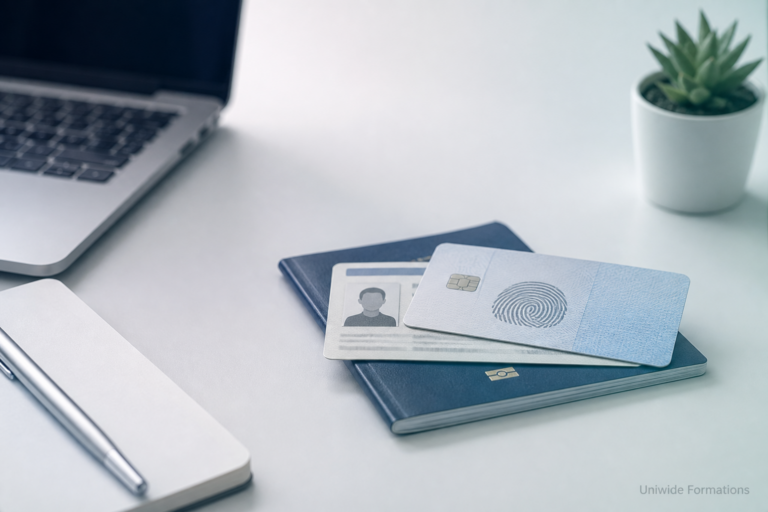
If you are planning to set up a new UK company, you will need to meet the proof of ID requirements before Companies House will accept your application. The proof of ID requirements are not optional; a company cannot be incorporated, and filings cannot be accepted, without them. This article was written to address some of the confusion about which checks apply, and why. We will explain what proof of identity involves and the documents accepted under each set of checks.
- ECCTA identity verification and MLR 2017 anti-money laundering checks are legally distinct — satisfying one never satisfies the other, even when the same firm conducts both.
- ECCTA verification is typically a one-off yielding a personal code, whereas AML due diligence must be refreshed on an ongoing, risk-based basis.
- The ACSP route accepts broader document combinations than GOV.UK One Login, making it more practical for those lacking a biometric passport or UK address history.
- Acting as a director without verified identity is an offence by the company and every officer in default.
What Are the Proof of ID Requirements?
The proof of ID requirements are designed to ensure that a person forming, directing or controlling a UK company is genuinely who they claim to be. Under the Economic Crime and Corporate Transparency Act 2023 (ECCTA), directors, company secretaries, members, general partners, managing officers and persons with significant control (PSCs) must all complete the identity checking process. This applies no matter whether the company is formed directly through Companies House or through a formation agent such as Uniwide Formations.
If you use a company formation agent, you will also need to complete anti-money laundering (AML) checks. Many founders do not realise that the Companies House identity ECCTA verification and anti-money laundering due diligence checks are two different things. These checks are often carried out around the same time and can use overlapping documents, which is why they are so easily confused. Completing one check does not satisfy the other. A director may have verified their identity with Companies House and still be required to provide further information to a formation agent carrying out its own AML checks, and vice versa.
Who Needs to Provide Proof of ID?
Anyone taking on a defined role within a new or existing UK company must provide proof of ID. This includes:
- Company directors
- Company secretaries who file documents
- Members and general partners
- Managing officers
- Persons with significant control (PSCs)
In most cases, ECCTA identity verification only needs to be completed once, after which Companies House issues a personal code used for all future filings. AML due diligence, however, is not a one-off exercise and may be repeated or refreshed depending on the formation agent’s ongoing obligations, according to the compliance requirements for company formation.
What Does the Law Say About Proving My Identity?
The Economic Crime and Corporate Transparency Act 2023 states the identity of proposed officers and persons with significant control must have their identity verified. Section 43 states, “An individual must not act as a director of a company unless the individual’s identity is verified”. The law requires that a verification statement must be provided by the authorised corporate service provider confirming that it has verified the identity of the applicant in accordance with the regulations.
The law also makes it clear that not meeting this requirement may mean that an offence is committed by the company and every officer of the company who is “in default”. As such, this is a legal requirement that cannot be overlooked or bypassed.
An Authorised Corporate Service Provider (ACSP) is a formation agent, accountant or legal adviser authorised by Companies House to carry out identity verification checks on behalf of clients. They can make the proof of ID process easier for company founders.
Because an ACSP is already registered with an AML supervisory body, it can carry out identity verification and its own AML checks at the same time. This does not mean the two checks become one. The ACSP must still keep separate records for each check. Identity verification and AML due diligence stay legally distinct, even when the same firm carries out both.
Proof of Identity Under ECCTA 2023
Proof of identity under ECCTA 2023 can be completed in two ways, as follows:
Verification Through GOV.UK One Login
When identity is verified directly through GOV.UK One Login, the applicant must hold one of a defined set of documents:
- a biometric or machine-readable passport (or Irish passport card) from any country
- a UK, Channel Islands, Isle of Man or EU photocard driving licence
- a biometric identity card from the EU, Norway, Iceland or Liechtenstein
- a UK Biometric Residence Permit
- a UK Biometric Residence Card
- or a UK Frontier Worker permit.
Only one document is required, since the check is fully digital and relies on the document’s own security features to confirm authenticity. The full, current list of acceptable proof of identity for this route is published on the government’s dedicated guidance page.
For ease of mind, many company directors choose to be verified through an Authorised Corporate Service Provider (ACSP), sometimes referred to as a Companies House authorised agent. Uniwide Formations offers identity verification services to clients forming UK companies.
When verification is carried out by an ACSP, there are two accepted options – an automated or manual check.
- Under an automated check, the applicant provides one photographic document from the same list as the One Login route, plus an eVisa.
- Under a manual check, carried out in person or remotely, the applicant provides two documents in total: either two photographic documents, or one photographic document and one supporting non-photographic document such as a bank statement, utility bill or council tax statement showing their current address. The complete list of documents accepted is set out in the government’s guidance on how to meet the Companies House identity verification standard.
Because ACSPs must apply this standard consistently, the proof of ID accepted through this route is often broader than the One Login list, allowing more flexibility for clients who do not hold a biometric passport or UK driving licence.
Proof of Identity Under MLR 2017
Proof of identity under MLR 2017 works on a different basis. The list of acceptable documents for MLR identity checks is determined by the company formation agent carrying out the anti-money laundering checks, not by Companies House, based on its own risk-based policies. This matters because a document accepted for ECCTA identity verification will not automatically be accepted for AML purposes, and vice versa.
How the two checks compare
| ECCTA Identity Verification | AML Due Diligence |
|---|---|
| Required under the Economic Crime and Corporate Transparency Act 2023 | Required under the Money Laundering Regulations 2017 |
| Carried out through GOV.UK One Login or by an ACSP | Carried out by the formation agent itself |
| Accepted documents set by Companies House standards | Accepted documents set by the agent’s own risk-based policy |
| Usually completed once – a personal code covers future filings | Ongoing – may be repeated or refreshed over time |
Proof of ID for Non-UK Residents
Non-UK residents forming a UK company face additional considerations when providing proof of ID. The One Login route accepts biometric passports from any country, but individuals without a qualifying document, or without a UK-based method of verification, will often need to use the ACSP route instead.
Formation agents may also carry out ‘enhanced due diligence’ for AML purposes if a client is based overseas or connected to a higher-risk jurisdiction, regardless of how straightforward the ECCTA identity verification itself has been.
Non-residents also face practical constraints that UK-based applicants rarely encounter. The GOV.UK One Login service is designed with UK verification pathways in mind, so applicants without a UK address history or a recognised UK-issued document may find the process less straightforward, even where their passport itself qualifies. In these cases, verifying through an Authorised Corporate Service Provider often provides a more practical route, since ACSPs are equipped to handle a wider range of document combinations.
Formation agents typically request additional information from overseas clients as part of their own AML due diligence, separate from the ECCTA check. This can include confirming the source of funds, the nature of the proposed UK business activity, and, in some cases, evidence of address history spanning several months. Clients connected to jurisdictions considered higher risk should expect this process to take longer and involve closer scrutiny of ownership and financial background.
Proof of Address
While proof of identity confirms who a person is, formation agents and, in some cases, Companies House will also require proof of address as a separate piece of evidence. This is typically a recent bank statement, utility bill, or council tax statement showing the applicant’s current residential address.
Acceptable Documents as Proof of Identity and Address
As proof of identity, you must provide at least one of the following documents, which must be current and valid:
- Passport
- Photocard driving licence
- National identity card
- UK residence permit
As proof of address, you must provide at least one of the following documents. Each must show both your name and address and be dated within the three months before we receive it:
- A utility bill (for gas, electricity, water, internet, TV licence, etc.) linked to the property – not a welcome letter or a final bill
- A landline telephone bill – mobile phone bills are not accepted
- A statement from a bank or building society – from a recognised bank, not an e-money institution
- A credit card statement
- A mortgage statement from a recognised lender
- A Notice of Tax Coding from HMRC (His Majesty’s Revenue and Customs)
- A poll card
- For students of UK universities: a letter from a recognised university bearing the official campus address, confirming your enrolment, course dates and your address (including any room number)
Wider Reforms Behind the Proof of ID Requirements
The introduction of proof of ID requirements was part of a broader package of reforms aimed at strengthening the powers and objectives of Companies House. These changes gave the registrar new abilities to query, reject and remove information from the register, alongside the identity verification regime itself.
As such, Companies House now has an active role in verifying the accuracy of the register, rather than acting purely as a passive recorder of filed information.
Two Checks, One Formation Process
Proof of ID requirements apply throughout UK company formation, separate from a formation agent’s own AML due diligence obligations. Knowing which check applies, what evidence each one accepts, and why the two should never be treated as interchangeable, helps founders avoid unnecessary delay when setting up a company.